The Two-Million-Word Problem
Every admissions cycle, faculty at PA programs commit to holistic review—treating every applicant as more than a number—but the reading load has grown into millions of words.

Admissions committees promised to read every application holistically. Nobody promised them the time.
In the 2025-2026 CASPA cycle, admissions committees at PA programs fielded applications from 35,280 people. Each application arrived carrying a personal statement of up to 5,000 characters: the case for why its author wants this life, compressed into about 800 words, revised over months, and read in minutes. And because the average applicant applied to about eight and a half programs, the same essay was read again and again, at different tables, by different tired committees: nearly 300,000 application files in all.
In the 2026-2027 cycle, committees will read more. When the cycle opened in April, the CASPA Life Experiences essay, which for several cycles an applicant could skip, became mandatory, its prompt rewritten to ask how one's life has prepared one to empathize with the communities one hopes to treat. An optional essay on artificial intelligence appeared beside it. Nobody consulted the readers. The required writing simply grew by half, the way assignments tend to grow, because asking for words costs nothing. Reading them is another matter.
Consider the arithmetic at a single mid-sized PA program. Fifteen hundred applications arrive in a cycle, each carrying roughly 1,200 words of essay and several hundred more in experience descriptions and letters of recommendation. That comes to something north of two million words of prose.
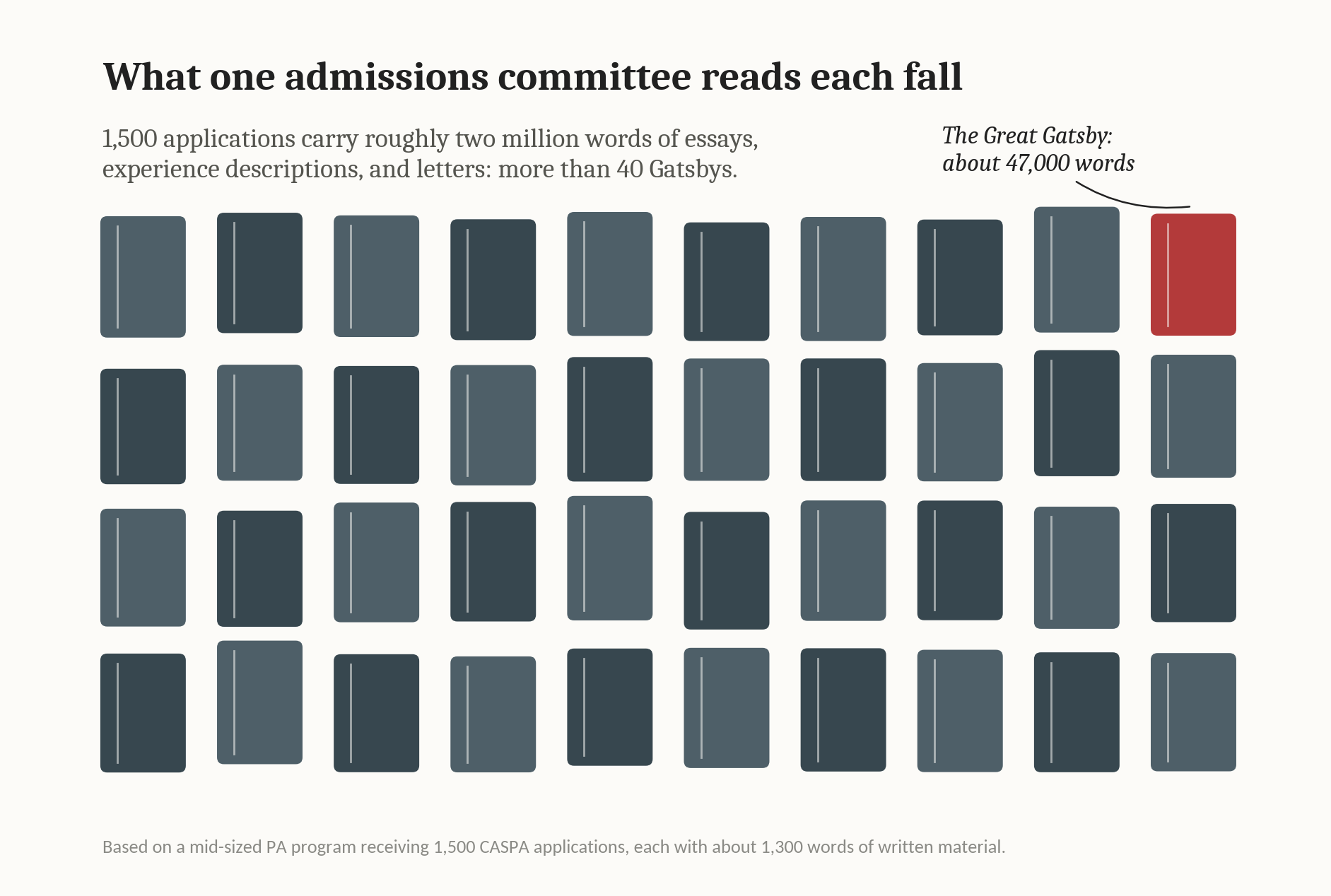
The Great Gatsby runs about 47,000. The admissions committee at such a program will read more than 40 Gatsbys this fall, between lectures and clinic and advising, mostly before Thanksgiving, and mostly uncompensated. The same arithmetic runs at medical schools and residency programs, where the pools are larger and the reading window is shorter.
Nobody designed this. It is what happens when a competitive profession, a centralized application service, and the economics of applying compound one another. Applicants respond to competition the only way they can, by applying more widely, which multiplies the reading further, and the resulting volume lands unevenly: a program might receive 500 applications for its cohort, or 5,000. Medical schools, with larger pools still, field several times as many. The particulars vary. The condition does not. Everyone in admissions is reading more than any reasonable person would agree to read, and the load grows every year, and almost no one talks about it.
Holistic review, the commitment to weighing an applicant's whole story rather than sorting by grades, is now the stated ideal of nearly every health-professions program in the country, and it is an admirable one. The AAMC established its Holistic Review Project in 2007 to give medical schools practical tools for weighing an applicant's experiences and attributes alongside the metrics, and codified the approach in Roadmap to Diversity in 2010 and Roadmap to Excellence in 2013. PA education adopted the same logic, and residency programs have been applying it more recently still. Holistic review is now the stated ideal of nearly every health professions program in the country, and it is an admirable one.
But ambitions for holistic review have expanded in precisely the years where its reading load exploded. It is also, in practice, an unfunded mandate. Holistic review is fundamentally a promise from admissions committee members to pay attention to all of the dimensions of each applicant's file, and attention is the one resource an admissions office has less of every cycle.
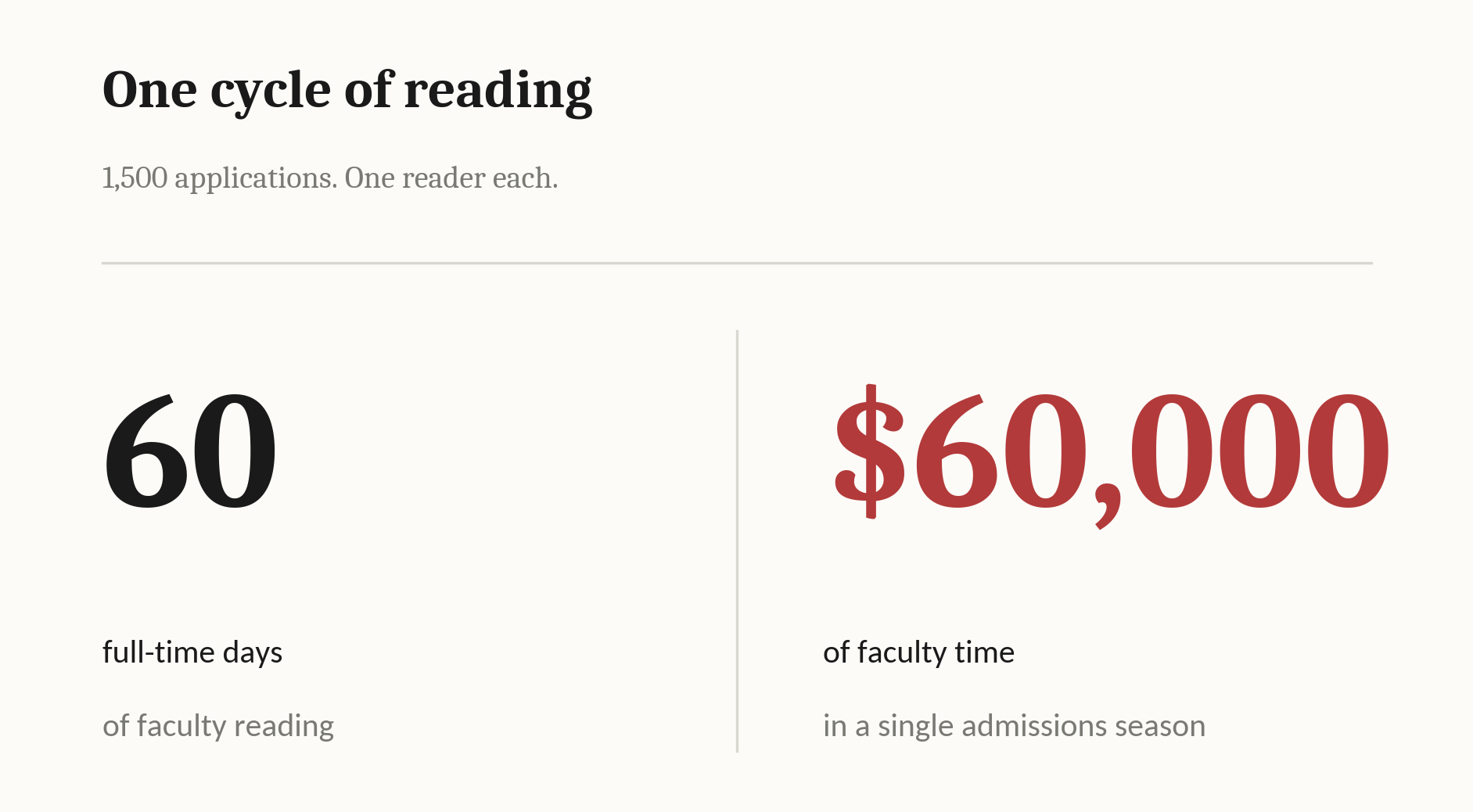
The promise of holistic review has a price, and it is payable in hours. A careful read of one file takes perhaps 15 to 20 minutes. At 1,500 applications, that is about 500 hours of reading, or roughly 60 full-time days. Most programs serious about holistic review send each file to two readers, which doubles the figure to about 120 full-time days, the better part of half a working year, absorbed by faculty who also teach, precept, and advise, and compressed into the autumn because rolling admissions rewards the programs that decide fastest. The committee member reading file number 40 on a Sunday night in October is not a caricature of a broken system. Their after-hours work is the system, working as designed.
There is a research literature on what happens to human judgment under this kind of load, and none of it is reassuring. Evaluators making long runs of sequential decisions drift: their scores sag late in a session, anchor on whatever came just before, and retreat toward the safe middle as fatigue accumulates. Admissions researchers have documented meaningful disagreement between trained raters scoring the same essay on the same rubric, under good conditions, with coffee. What those raters do at file 1,400 has attracted rather less study, possibly because no one is eager to learn the answer.
So the field triages, mostly without saying so. GPA thresholds make the first cut. Skims and keyword scans make the second. The full holistic read, the one described in the mission statement, is reserved for the files that survive. None of this is scandalous; it is arithmetic. But the arithmetic has a distributional consequence. The applicants most likely to be erased by a skim, the career changers, the late bloomers, the people whose case lives in the essay rather than the transcript, are precisely the ones holistic review was invented to see. A system can hold an ideal and lack the hours to practice it.
There is an irony in this cycle's newest CASPA application essay requirements. The application system's first formal acknowledgment of the age of artificial intelligence was an essay prompt: an invitation for more words, written by humans, to be read by humans who ran out of reading hours several cycles ago.
How programs should respond is an open question. Some are adding readers. Some are optimizing their screening requirements for reduced committee workloads. Some are running careful experiments with technology, and the field's journals are only now beginning to host the debate about what that should and should not look like. We will cover all of it here in the months ahead.
But the first step is smaller and harder: naming the condition. Holistic admissions is a massive reading commitment before it is anything else. Unfunded, shouldered on the backs of admissions committee members on Sundays, holidays, and after hours. Millions of words per cycle, year over year. This is a good year to look at this challenge directly and see what we can do about it.
This is the first in a series on the craft and science of health-professions admissions. Expect research summaries from JPAE, NEJM AI, and the broader literature, reporting on how programs are adapting, and occasional service pieces for the conference season.
Sources: PAEA CASPA Applicant Trend Numbers, 2021 to 2026 cycles; PAEA CASPA Matriculation Data, 2020 to 2025; CASPA 2026-2027 Applicant Guide; AAMC Holistic Review Project, Roadmap to Diversity (2010) and Roadmap to Excellence (2013).