Endorsed, Not Agreed
PA education's first consensus statement on AI lands just weeks before the annual PAEA conference convenes in Austin.
PA education's first consensus statement on AI lands just weeks before the annual PAEA conference convenes in Austin
On August 11, the Journal of Physician Assistant Education published something PA education has not had before: a formal consensus statement on artificial intelligence in PA education, developed over twelve months and endorsed by a thirteen-member expert panel from the PAEA AI SIG, including members of our own staff at Meshwell (our CEO is the corresponding author). The consensus statement is well timed. In just a few weeks, PA educators will gather in Austin for the PAEA Education Forum to debate the ideas in this consensus statement as they discuss what AI means for PA education.
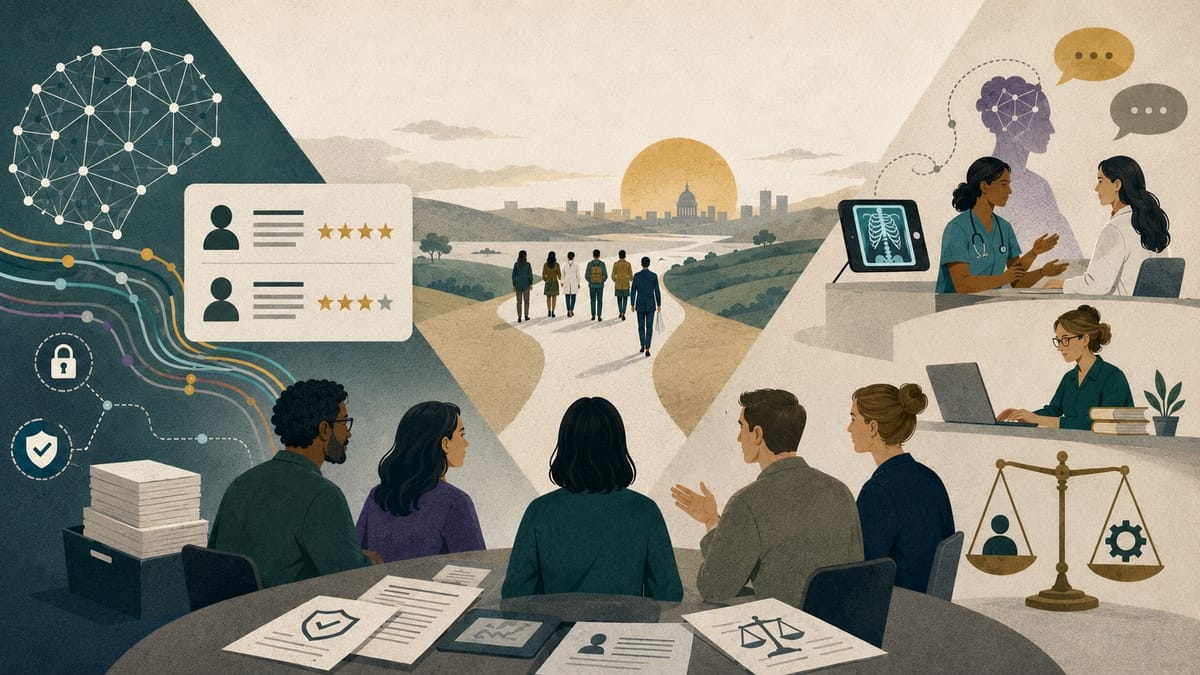
This new paper in JPAE is a comprehensive statement, covering the use of AI in every aspect of PA education: assessment, teaching, admissions, faculty workflow, and AI competencies. So it's worth reading the original source article; it's open access, but it's also a long read. Here are some of the highlights.
Assessment and academic integrity. You might have seen reports of AI tools completing entire online courses within days. The initial reaction to that might be to prohibit the use of AI in student assignments. But realistically, there is no bulletproof way to detect AI usage, and without a path to enforce a policy like that, the program risks eroding its authority and reputation. The committee recognized that and recommended against enforcing prohibitions. Instead, they recommended redesigning assessments. At least some of these assessments should be proctored, where the use of AI technology can be effectively controlled for all students, either banned or titrated, but either way intentional.
AI as a learning tool. When AI is used as a learning tool, it should not be used as a cognitive shortcut. For example, if you assign a bank of multiple choice questions, students should not be incentivized to use AI to copy-paste those multiple choice questions into a chatbot to spit out the answer. On the other hand, AI tools that simulate a patient or provide the student feedback on their diagnostic ability and guide them through the process of reasoning about patients could actually accelerate learning. And AI tools can extend a program's ability to deliver critical content when faculty expertise isn't available, like with RadClerk (also founded by our CEO) that PA programs, medical schools, and NP programs use to deliver hands-on radiology training.
Admissions. The volume of applications ranges from five hundred to five thousand across PA programs, and easily past 5,000 applications with medical schools. Currently, faculty are tasked with reviewing these applications manually on their personal time. For these overworked admissions teams, the question isn't whether to use AI, but how to use it responsibly. The consensus statement provides guidance in this regard, helping admissions teams focus on issues like compliance and reliability. The consensus statement emphasizes that whatever AI software is used, it needs to be trustable, secure and validated, and human faculty need to remain at the center of the admissions process.
The consensus statement emphasizes that whatever AI software is used, human faculty need to remain at the center of the admissions process.
Faculty workflow. All too often, faculty are assigned administrative work that pulls them away from mentorship, teaching, and scholarship. The consensus statement recognizes administrative work as a prime target for the use of artificial intelligence.
AI competencies. As we graduate students into the age of AI, they need durable competencies that will help them thrive as the technology changes. The committee acknowledged that it would be impossible to forecast the precise skills needed, but they emphasized the need for teaching durable competencies rather than transient skills. Examples of durable competencies included appraising AI output, resisting automation bias, data governance, and ethical use. And an example of a transient skill would be prompt engineering, the need for which might change month to month as new AI models are released.
Examples of durable competencies included appraising AI output, resisting automation bias, data governance, and ethical use.
Not every item passed comfortably, and the title of this post reflects that. Two positions drew ratings across the full one-to-nine scale: lifting remaining prohibitions on applicant AI use, and restricting general-purpose chatbots in admissions review. Both cleared the endorsement threshold, but the spread is the honest state of the field. The panel is also candid about its limits: members self-selected from an AI special interest group, so the statement leans toward educators already engaged with the technology.
So what does this consensus statement mean for those of us that are thinking about AI in our own admissions process? Two developments reported in the statement are immediately practical. First, CASPA policy for the current cycle now permits applicants to use AI for non-substantive changes, spelling and grammar among them, while requiring that the final submission accurately represent the applicant's own work. If you read the first post in this series, about the two million words a PA admissions committee reads each fall, you now know the other half of that story: the words are now allowed by CASPA to arrive with machine polish. Second, ARC-PA has stated in its guidance that nothing in its standards prohibits admissions committees from using AI, as long as the criteria used to assess applicants are published to prospective students. Many programs assume the opposite, and the ARC-PA has removed a barrier that most believed was there.
What's the bottom line for PA programs grappling with their own AI policies? The consensus statement's own answer is to move from reactive policy to deliberate policy: proctored summative assessment, removing unenforceable AI bans on unproctored work, standards for educational experiences that avoid AI-based cognitive shortcuts, and human judgment retained at the heart of admissions.
A consensus statement does not end an argument. Instead, it locates a general direction for policy, and invites continual revision. We see this paper as an important signal for where PA education is headed, but also just the start of a continual discussion as we enter the AI era for medical education.
This is the third in a series from Meshwell on the craft and science of health professions admissions.
Study referenced in this analysis:
"PAEA Special Interest Group Consensus Statement on the Application of Artificial Intelligence in Physician Associate Education", Journal of Physician Assistant Education, August 2026, open access.
- This work was generously funded by the Rocky Vista University Office of Research and Scholarly Activity and the Lincoln Memorial University School of Medical Sciences Doctor of Medical Science Program.
- Our CEO and Research Associate at Meshwell led this work, along with 12 PA faculty from across the country.