Ask Better Questions
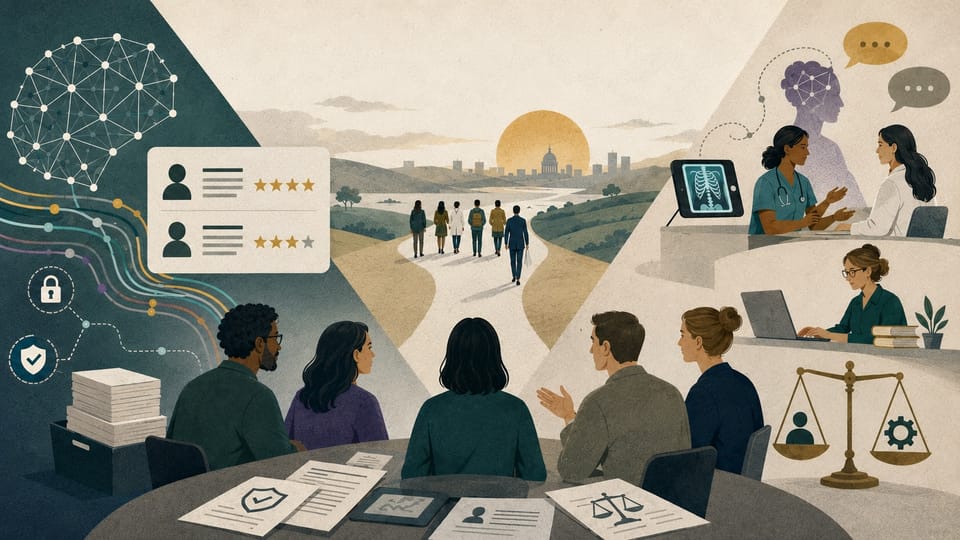
AI didn’t break the personal statement. The deeper challenge is designing an admissions process that asks better questions, evaluates applicants consistently, and connects written claims to meaningful conversation.
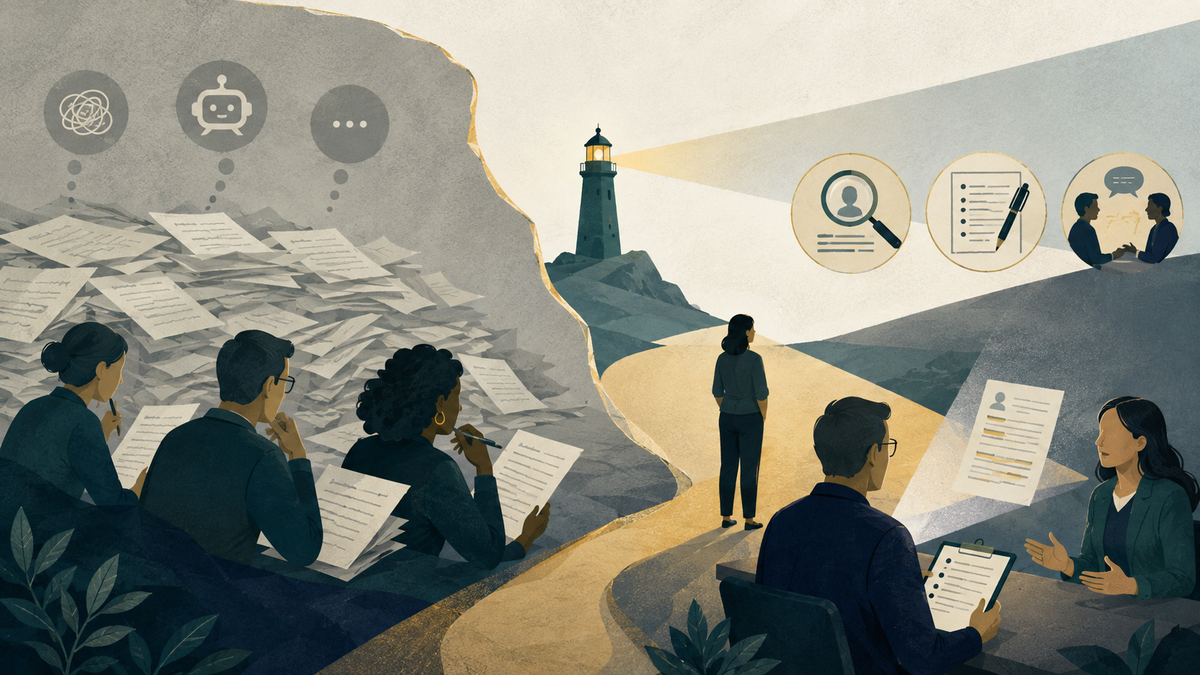
Reports of the personal statement's death are greatly exaggerated.
Admissions committees are asking a question that would have sounded strange three years ago. Is there any point in reading personal statements when a chatbot may have written them? The worry makes sense. Every applicant now has a skilled ghostwriter on call, and every program knows it.
Research from the past year offers an answer, but not the expected one. Four teams put human-written essays and their AI-polished versions in front of real reviewers. The tests ran at medical schools and in pediatric and orthopaedic surgery residency programs. The scores for AI-polished essays barely moved compared with their original human-written versions. In short, reviewers are largely unswayed when applicants polish their essays with AI. Whatever is wrong with the personal statement, ChatGPT is not it.
The rulebook is already adjusting to the reality that AI usage is widespread with applicants. CASPA, the central application service for PA programs, initially banned generative AI outright in its 2025-26 applicant agreement. Applicants could not use it to create, write, or modify anything they submitted. The 2026-27 rules ease that stance. Applicants can now use AI tools to fix spelling and grammar, but the substance must be their own work, and each program can set stricter rules.
Either way, detecting the use of AI based on essay content is completely impractical, and that's also being recognized. PAEA, which runs CASPA, also stated it will not open an integrity investigation based only on an AI detection flag, because detection tools wrongly accuse human writers far too often. Taken together, this points in a healthy direction for admissions policies. They are quickly adapting to the reality that policing AI use in written statements is close to impossible. And that approach leaves room for what the new studies suggest: that students using AI to polish applications may not matter much to the admissions process anyway.
Personal statements...have bigger and older problems than AI use among applicants.
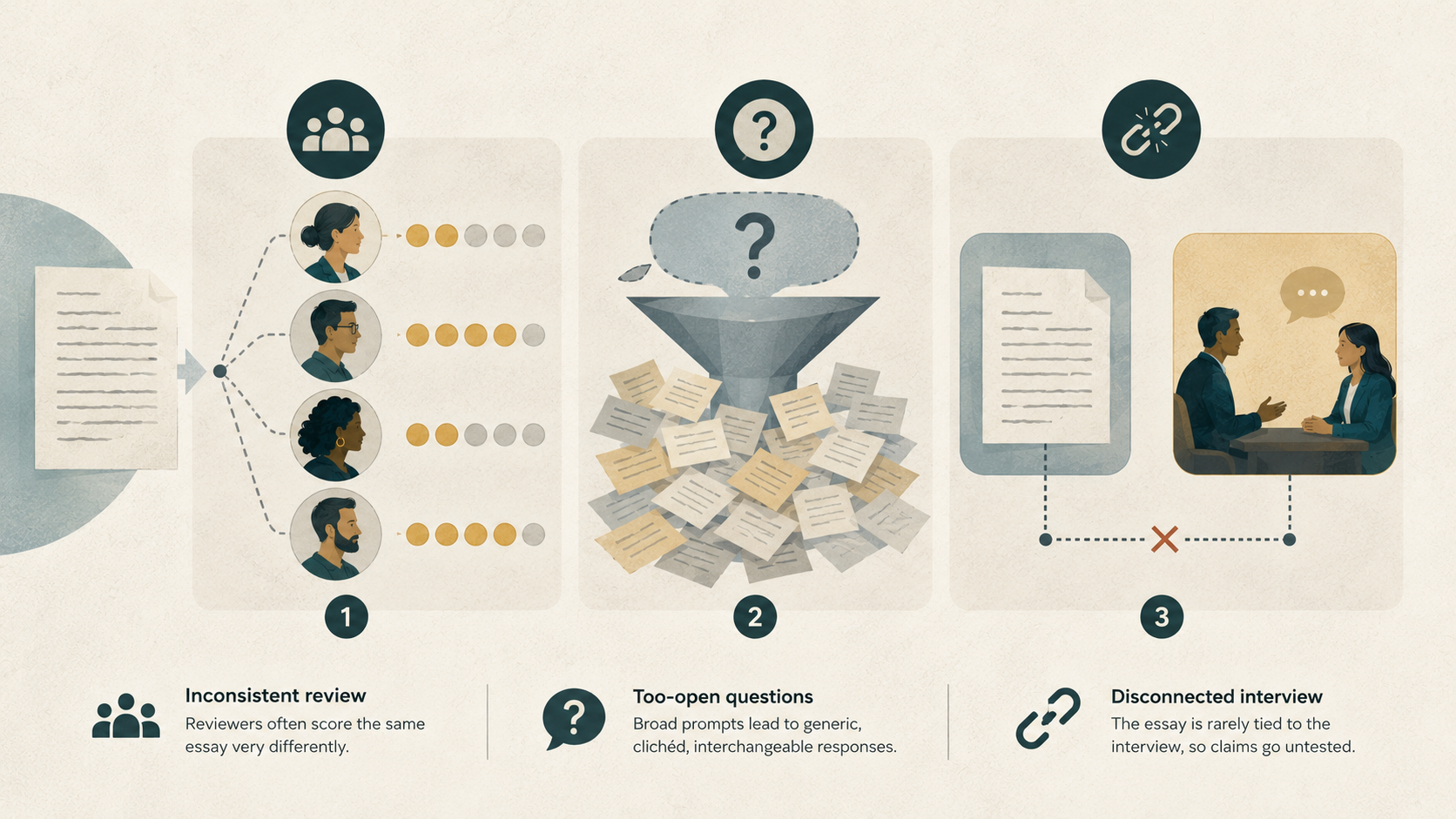
Publications from the past few months related to the use of generative AI in applicant essays suggest that personal statements actually have bigger and older problems than AI use among applicants. Recent papers in the admissions literature point to three age-old issues with personal statements. First, scoring a personal statement is severely affected by inter-reviewer variability. Second, essay questions are too open-ended - they elicit generic and cliched responses. And third, interview questions are completely disconnected from the written statements students submit, so students are never held accountable for proving they authentically represent the writing and claims in their essays. Each of these three problems is worth a closer look.
Reviewers don't agree with each other
The first sign of trouble sits with the limitations of the humans reviewing personal essays. In one study from a medical school, eight raters scored the same essays, and their scores mostly disagreed with each other. In another study at a pediatric residency program, the raters' agreement was worse than what random chance would produce. Four faculty members from that program read the same statements, used the same rubric, and landed in different places.
These numbers have nothing to do with artificial intelligence. They show what happens when people judge open-ended writing on general impressions. Researchers have reported this problem with admissions writing samples for decades. And scoring this inconsistent can't tell you much about an essay, no matter whether it was hand-crafted or polished with AI.
The authors of one of those studies recommend that medical schools drop personal essays altogether. That view deserves a fair hearing. Any faculty member who has spent a December buried in application files has felt its pull. But two less visible papers in the recent literature point somewhere more useful.
The essay question is too open
A commentary this year in the American Journal of Pharmaceutical Education looked at a related corner of the same problem. It examined the written materials used to pick pharmacy residents and fellows. Those include recommendation letters and the letter of intent, which is pharmacy's version of the personal statement.
The authors found that more specific writing was more predictive. For example, broad praise in a recommendation letter predicts almost nothing in terms of student performance, whether that's a high numeric rating, or phrases like "outstanding" and "hardworking". Instead, they suggested that writing tied to specific behavior could be more useful. For example, a personal essay describing one particular decision point, or one documented moment of growth, is far more useful. For whatever reason, specific examples do a better job of predicting how candidates perform once they reach the interview, whether in recommendation letters or personal statements.
The lesson points towards how we might make better use of the existing application process. The general personal statement is baked into most common applications, but we might not need to throw it out. Instead, we could score these statements for the quality and nature of their particular examples, rather than rewarding broad, generic statements. And the secondary application is a place where programs have always asked more specific questions of the applicant.
The research only makes the secondary written statements more essential, and worthy of a second look. Do your secondary questions elicit the sort of concrete, focused examples that represent specific, lived experience instead of general sentiments? Instead of throwing out the entire process, research suggests there's a lot to be gained through more directed adjustments to grading rubrics and essay questions. The bottom line for sharpening your essay questions: open questions like "tell us about yourself" invite meaningless responses. Specific questions demand that the applicant demonstrate substantive experiences, which is the one thing generative AI cannot magically create.
The interview never comes back to the essay
Then there is what happens to the essay after it's scored. In most programs, the essay is as interesting as stale bread once interviews are offered. An Academic Medicine article this year argues that programs should reconsider, and keep written statements in focus. Its main recommendation: build interview questions that point straight back at what the applicant wrote.
Pointing interview questions back at the essay is another minor but directed adjustment that can yield outsized benefits. And even though it costs a program almost nothing, few programs do it. When the essay is discarded after interview selection, students are free to embellish on their essay without any chance of being challenged to speak extemporaneously on their written statements. When you advertise to the applicant that they will be questioned on their written materials, something fundamentally different happens. The author knows they will need to stand behind their words. The written statement becomes preparation for a real spoken conversation, instead of a theoretical writing exercise for an AI assistant. And the interview gains real, specific material to work with. A candidate who wrote about a moment of clinical doubt, and can talk about it for ten unrehearsed minutes, has shown you something no score on a page ever could.
And it's not just health professions programs that are thinking in this direction. Caltech now invites undergraduate applicants who submit research to record a short video explaining that work in their own words. And for many years, going back over two decades, interviews for Harvard's MD-PhD program required applicants to be able to fluently discuss their research and future trajectory in person. But even in the highest echelons of higher education, this principle isn't uniform. Many of MIT's undergraduate admissions interviews happen without reference to the application materials. While this approach is a legitimate and reasonable attempt to evaluate the candidate with a fresh eye, the drawback is a missed opportunity to hold the applicant accountable for their words. So in case you're still feeling indecisive about your program's approach, you're not alone.
How it got this way
None of these problems related to reviewing applicant written materials came from committees that stopped caring. They came from the brutal arithmetic of the workload placed on admissions committees by holistic review. A twenty-year report on the central application service for physician assistant programs came out this summer. It tracks applicants rising roughly fivefold, to 28,445 by 2021, while the share who matriculate drifted down to between 31% and 41%. Programs read far more to admit about the same number of people. Medical schools, graduate and undergraduate nursing programs, pharmacy schools, and others sit on the same curve at different scales.
Under that pressure, the open-ended essay and the quick gut-feel rating are not laziness. They are survival. Specific questions take longer to score. Training raters to use behavioral anchors takes calibration meetings that faculty do not have time for. Interviews that engage the essay require interviewers who have read the essay. The personal statement was hollowed out long before AI, because hollowing it out was the only way through the pile before interview season.
The tempting shortcut now is the cutoff score, and a new study shows why that path (returning to metric-based admissions from 20+ years ago) also needs care. In that study, a physician assistant program modeled five years of its own applications. What if it had cut everyone scoring more than one standard deviation below the mean on CASPer, a common situational judgment test? The cutoff would have removed 16.5% of applicants. It would have shrunk the share of underrepresented minority applicants in the interview pool by 12.5%, even though CASPer scores have previously shown no significant differences by race or gender. That research presents a caution to any program that reaches for exclusively score-based cutoffs as a way to handle the overwhelming workload of holistic review.
The evolution, not the obituary
The latest work from the admissions literature makes it clear: AI did not break the personal statement. It exposed cracks that were already there: inconsistent grading between reviewers, open-ended essay questions with bland vacuous responses, and interviews that never challenge the applicant to defend their writing. Sharpening the essay questions in your secondary application could be one path to closing these cracks. Sharper questions give your reviewers more concrete standards to score against. And with more specific answers from candidates, your interviewers will have specific things to ask applicants to defend and explain at the interview. And all of this applies whether or not the applicant used AI to polish their essays. Programs that cannot invest in any of this iteration may honestly be better off dropping the personal essay than keeping it for show. Either way, applicants using AI was never the problem.
Studies referenced in this analysis:
- Vaccaro et al. "Death of the Personal Statement: Qualitative Comparison Between Human-Authored and Artificial Intelligence-Generated Medical School Admissions Essays." Journal of the American College of Surgeons, December 2025. DOI
- Choi et al. "Investigating the threat of AI to undergraduate medical school admissions: a study of its potential impact on the rating of applicant essays." Canadian Medical Education Journal, December 2025. DOI
- Curry et al. "Re-evaluating the role of personal statements in pediatric residency admissions in the era of artificial intelligence: comparing faculty ratings of human and AI-generated statements." Canadian Medical Education Journal, December 2025. DOI
- Avetisian et al. "Indistinguishable Narratives: A Blinded Comparison of AI- Versus Human-Written Personal Statements in Application to Orthopaedic Surgery Residency." Journal of Graduate Medical Education, April 2026. DOI
- Cournoyea et al. "Rethinking the personal statement in the AI era." Academic Medicine, February 2026. DOI
- Bradley et al. "From Pen to Prompt: Navigating LLM-Generated Content in Postgraduate Pharmacy Training Applications." American Journal of Pharmaceutical Education, February 2026. DOI
- Hussaini et al. "Central Application Service for Physician Assistants 20-Year Data Report 2002 to 2021." Journal of Physician Assistant Education, July 2026. DOI
- Lolar et al. "Impact of CASPer Cut Score on Diversity in Physician Assistant Program Admissions." Journal of Physician Assistant Education, July 2026. DOI